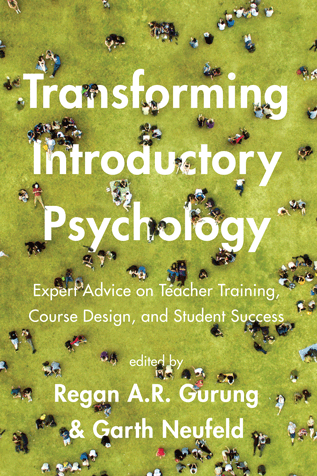
Addresses introductory-course outcomes, course design, teacher development, and student success. Institutional cases show how the APA initiative was applied in different US teaching settings.
Teaching use: Compare a course goal with the task used to assess it.
Access, inspection and cover source
Purchase or library access.
Publisher catalog and contents inspected; full book not reviewed. US-focused initiative and cases.
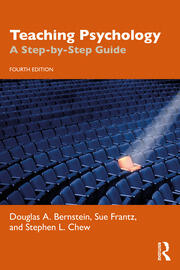
Covers course preparation, the first classes, grading, technology, teaching evaluation, and teaching abroad. Its remit extends beyond the introductory survey to the work of teaching psychology.
Teaching use: Compare your plans for the first class, grading, technology, and course evaluation.
Access, inspection and cover source
Purchase or library access.
Publisher description and contents inspected; full book not reviewed. Fourth edition has copyright 2025 and a publisher-listed release date of 11 December 2024.
An introductory-course collection organized around class structure, access and inclusion, and assessment. Chapters include content selection, open science, collaborative work, cultural psychology, and assignment design.
Teaching use: Choose one teaching problem and compare the relevant chapter with your present lesson or assignment.
Access, inspection and cover source
Purchase or library access.
Publisher metadata, description, and contents inspected; full book not reviewed. The collection is framed around the APA Introductory Psychology Initiative.
Combines a history of the introductory course with preparation, topic-specific teaching, and end-of-course reflection. Chapters cover the major domains usually encountered in a survey course.
Teaching use: Compare an older teaching approach with current evidence and examples for the same topic.
Access, inspection and cover source
Purchase or library access; some front matter is freely available.
Publisher metadata and contents inspected; full book not reviewed. Scientific and technological examples date from the book’s publication period.
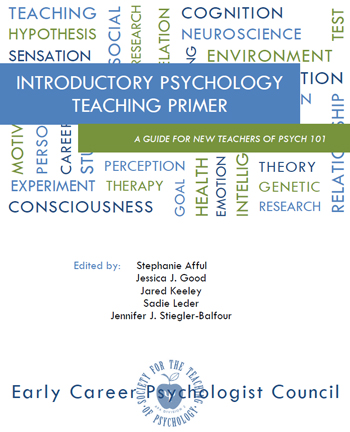
Stephanie E. Afful, J. J. G., Jared Keeley, Sadie Leder, & (eds.), J. J. S.-B. (2013). Introductory psychology teaching primer: A guide for new teachers of psych 101. https://teachpsych.org/ebooks/intro2013Book
A topic-organized collection for instructors teaching introductory psychology for the first time. It addresses students with varied interests, preparation, and reasons for taking the course.
Teaching use: Use a topic chapter to identify a lesson goal, activity, and assessment, then check the underlying evidence.
Access, inspection and cover source
Free ebook. Personal and classroom copying requires the stated attribution; wider distribution needs permission.
Official description, contents, copyright notice, and suggested citation inspected; full book not reviewed. This record describes the 2013 edition.
Describes psychology courses taught asynchronously, synchronously, and through mixed delivery. Foundational-course chapters sit alongside elective and advanced examples; planned online courses and pandemic adaptations both appear.
Teaching use: Compare how one activity’s purpose, instructions, and feedback change when it moves online.
Access, inspection and cover source
Free ebook. Classroom and personal copying permissions are specified; it is not offered under a blanket open license.
Official description, contents, legal notice, and recommended citation inspected; full book not reviewed. Jessica Cerniak’s name is confirmed by the publisher and a deposited title page.
Examines psychology teaching in UK and European higher education. Topics include student needs, statistics, research projects, assessment, online learning, and teaching psychology to other disciplines.
Teaching use: Compare assumptions about students, course structure, and assessment with those in US teaching guides.
Access, inspection and cover source
Purchase or library access.
Publisher metadata, description, and contents inspected; full book not reviewed. Copyright is 2010; Wiley lists first online publication in February 2009.
Examines how psychology instructors define, teach, and assess critical thinking. Its examples range from introductory courses to methods, statistics, and advanced study.
Teaching use: Turn a broad critical-thinking aim into a task with observable criteria for evaluating evidence.
Access, inspection and cover source
Purchase or library access.
Publisher metadata and contents inspected; full book not reviewed. The collection covers the psychology curriculum, not only introductory courses.
Stowell, J. R., & (eds.), W. E. A. (2017). Activities for teaching statistics and research methods: A guide for psychology instructors. https://www.apa.org/pubs/books/4316177Book
Provides teaching exercises on graphs, variables, confounds, uncertainty, research design, and ethics. The publisher organizes activities by topic, course level, and time required.
Teaching use: Select a task on confounds or graphs and compare its demands with your students’ methods knowledge.
Access, inspection and cover source
Purchase or library access.
Publisher description and contents inspected; full book not reviewed. A publisher description of classroom testing does not establish an independent effectiveness trial.
An introductory survey covering psychological science, biological processes, cognition, development, social behavior, health, disorders, and treatment. Online chapters and a downloadable edition allow teachers to inspect reading length and topic sequence.
Teaching use: Map required topics and reading load before choosing supplemental examples.
Access, inspection and cover source
Free online reading. The current official notice specifies CC BY-NC-SA; follow attribution, noncommercial, share-alike, and third-party terms.
Official citation and current license notice inspected on the book’s index page; full textbook not reviewed. That page confirms publication on 22 April 2020.
Cover source: OpenStaxOfficial OpenStax cover. See the source repository for its current license.
A Canadian introductory text assembled from original material and adapted open resources. Its contents include chapter self-tests and a section on the replication crisis.
Teaching use: Compare chapter structure, examples, and self-tests with your current reading assignments.
Access, inspection and cover source
Free online and downloadable formats. CC BY-NC-SA 4.0 except where otherwise noted; chapter attributions apply.
Official book metadata, contents, license, and source-attribution information inspected; full textbook not reviewed.
Jessica Motherwell McFarlane, A. L. S., Dinesh Ramoo, & Yousef, T. (2024). Introduction to psychology: Moving towards diversity and inclusion. https://opentextbc.ca/psychologymtdi/Book
A remixed introductory survey that draws on several open textbooks. Its organization provides a concrete example for examining representation and inclusion across a course’s readings.
Teaching use: Inspect whose research and experiences appear in a topic, then compare them with another textbook.
Access, inspection and cover source
Free online and downloadable formats. CC BY-NC-SA 4.0 except where otherwise noted; the cover image has separate terms.
Official metadata, contents, attribution, license, and publication date inspected; full textbook not reviewed.
A peer-reviewed collection of teaching activities, guides, lab materials, and annotated resources. Entries are organized by psychology course or topic.
Teaching use: Match a resource to an intended outcome, then inspect the evidence cited for its design.
Access and inspection scope
Public resources; copying and adaptation permissions vary by item.
Official resource index inspected. STP describes its review process; this does not establish that every activity has an independent effectiveness trial.
A repository of peer-reviewed psychology syllabi with a syllabus-design rubric. It includes introductory courses, online courses, and international examples.
Teaching use: Compare an assignment’s purpose, student support, policies, and progression with the review rubric.
Access and inspection scope
Public syllabi. Personal and classroom sharing requires credit; wider copying is not automatically permitted.
Official repository description, rubric information, category listing, and reuse notice inspected; individual linked syllabi were not all reviewed.
American Psychological Association. (n.d.-a). APA introductory psychology initiative. https://www.apa.org/ipiWebsite
Provides introductory-course learning outcomes, integrative themes, a pillar model, sample syllabi, and assignments. It states recommendations from a US professional initiative.
Teaching use: Compare the proposed outcomes and content model with your institution’s course requirements.
Access and inspection scope
Public guidance and linked resources; individual materials have their own terms.
Official initiative page and recommendation summaries inspected. It is a professional framework, not a worldwide curriculum requirement.
Supports secondary-school psychology teaching with standards, lesson plans, assessment guidance, and professional development. The resource collection includes guidance for new teachers and sensitive classroom topics.
Teaching use: Find a lesson or assessment guide appropriate to school-level psychology.
Access and inspection scope
Public and member-linked resources coexist; individual access and reuse terms vary.
Official resource page inspected. The organization’s standards and institutional context are US-based.
Offers modular psychology readings that teachers can assemble into a course text. Instructor manuals, slides, and test banks are available for many modules.
Teaching use: Select a focused reading that matches the lesson’s question and expected student work.
Access and inspection scope
Free readings; generally CC BY-NC-SA 4.0 except where otherwise noted. Instructor materials have separate access conditions.
Official homepage, module/textbook descriptions, and license notice inspected; all modules and instructor materials were not tested.
The European Society of Psychology Learning and Teaching connects psychology teachers and researchers. Its site lists conferences, webinars, resources, and the PLAT journal.
Teaching use: Find European teaching colleagues, webinars, and scholarship relevant to your course.
Access and inspection scope
Public pages and resources alongside member-only areas; event conditions vary.
Official organization homepage and history inspected. EuroPLAT is a historical predecessor, not the current organization name.
A federation of national and regional psychology teachers’ associations in Europe. Its main teaching context is pre-university education, generally students aged about 13–19.
Teaching use: Compare school-level psychology teaching contexts and teacher associations across Europe.
Access and inspection scope
Public research, presentations, and information; participation and event conditions vary.
Official homepage and organizational description inspected. Membership and national curricula do not represent a single European course.
Publishes research on psychology teaching, classroom resources, and assessment across educational levels. Articles address student learning as well as course and instructor practices.
Teaching use: Search for a study matching your topic, class level, and measured outcome.
Access and inspection scope
Mixed open and restricted articles; full text may require library or membership access.
Official journal landing page and stated scope inspected; individual articles were not all read.
Publishes empirical studies and reviews connecting psychological research with teaching practice. Its stated audience includes secondary-school, community-college, college, and university educators.
Teaching use: Find research on a teaching question, then check the study population, methods, and outcome measures.
Access and inspection scope
Mixed open and restricted articles; sample articles are linked from the journal page.
Official journal scope and access information inspected; individual articles were not all read.
No matching resources. Try another term or clear the filters.